ROADS TO FREEDOM
From the Exodus of Messolonghi to Nafplio
April 10, 1826
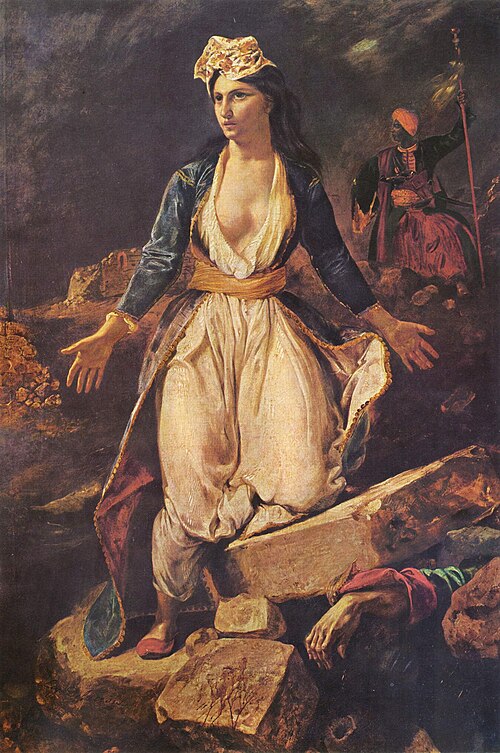
The painting is by Eugène Delacroix.
Title: Greece on the Ruins of Missolonghi
(in French, La Grèce sur les ruines de Missolonghi), painted in 1826.
It does not literally depict the battle, but rather an allegorical figure of Greece mourning over the ruins after the Exodus.
It is one of the most iconic works of Philhellenism and played a significant role in stirring international sympathy for the Greek War of Independence.
After almost 12 months of siege, the besiegers, Otoman army together with support from other parts of empire, have not managed to break the resistance of the Messolonghi warriors.
The Greeks have rejected the favourable proposals to surrender the city. However, the food is running out.
They unanimously decide to try to pass through the enemies in a desperate Exodus with the aim of going to Nafplio to the Government, which had abandoned them.
Unfortunately, the besiegers knew their plan and had prepared to intercept them.
The besieged crossed the moat, over wooden bridges they had built, emerging in three phalanxes.
With swords in hand, they opened roads through the besiegers with huge losses and with the monastery of Saint Symeon on the mountain as their first target.
Of the approximately 12,000 besieged, 2,500 foreign soldiers and 9,500 Messolonghi warriors and civilians, approximately 2,000 were saved, of whom – 1,500 foreigners along with some locals and only 300 inhabitants from Messolonghi apart.
Many were killed in the city either fighting or during the explosions of the Powder Storehouse and the Windmill.
Of the rest: – 4000 are killed and – 6000 women and children are sold as slaves outside the Walls.
From there, in two groups, they march towards Nafplio: – the most numerous via Roumeli arrive in Nafplio on May 20 – the Messolonghites via Nafpaktia, Dorida and Northern Peloponnese arrive in Nafplio on April 28.
We know their routes from the memoirs of fighters.
As is well known, the magnificent poem “The Free Besieged” was written by Dionysios Solomos about the Exodus, watching the siege from the neighboring island of Lefkada.
We want to honor this magnificent Exodus and the heroic courses of the Defendants of Messolonghi.